
You’re Probably Doing It Wrong: Asserting Privilege in Texas Discovery
Common Errors from the Bench—and How to Fix Them

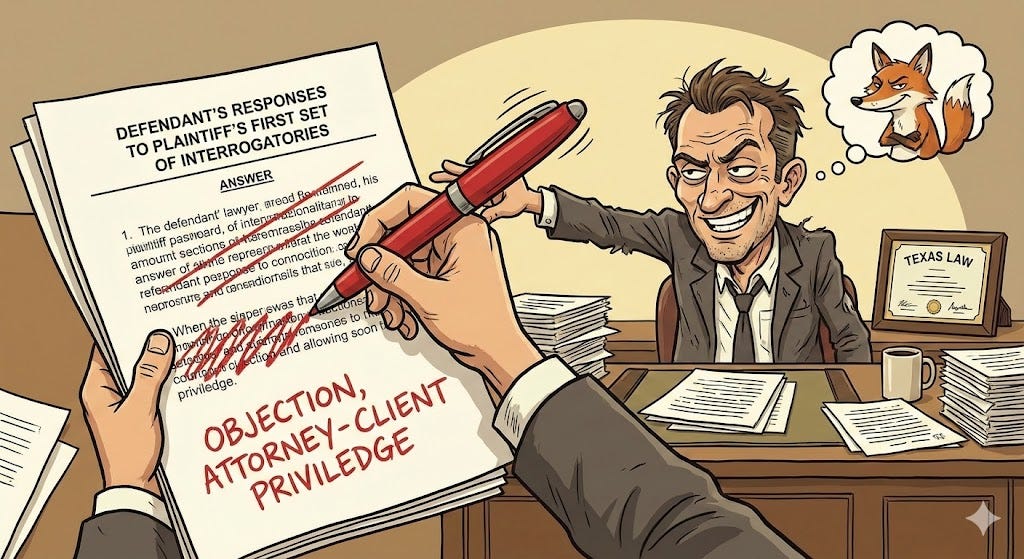
Privilege is not an objection.
That single sentence would resolve most of the problems I see from the bench when parties attempt to protect attorney-client communications from discovery. Yet attorneys continue to confuse the two mechanisms—sometimes with consequences ranging from unnecessary motion practice to outright waiver. What follows is a practical guide to what goes wrong, why it matters, and how to get it right under Texas Rule of Civil Procedure 193.3.
The Core Distinction: Objections and Privileges Are Not the Same Thing
The Texas Rules of Civil Procedure draw a sharp line between objections under Rule 193.2 and privilege assertions under Rule 193.3. They are different mechanisms, governed by different procedures, subject to different timelines. Treating one as the other is error.1
I still see discovery responses that read: “Objection. This request calls for the production of documents protected by the attorney-client privilege.” That response, standing alone, is procedurally improper. It raises an objection where the rules require a withholding statement. It tells the requesting party nothing about what’s being withheld. And it sets the stage for exactly the kind of satellite litigation the rules were designed to prevent.
The Eastland Court of Appeals put it plainly in In re Scherer: “It is improper to raise an objection to a discovery request on the grounds that it calls for the production of material that is privileged.”2 The court emphasized that there is a “significant distinction between raising objections and asserting privileges.”3
The correct approach? When you’re withholding responsive material on privilege grounds, say so directly. Your response should state (1) that responsive information or material is being withheld, (2) which discovery request or requests are implicated, and (3) the specific privilege or privileges you’re asserting.4 That’s the withholding statement. It can appear in your discovery response, an amended response, or a separate document—but it must exist.
Here’s the good news for those who’ve already made the mistake: an erroneous privilege objection doesn’t automatically waive the privilege.5 But once the error is pointed out, you’re obligated to comply with Rule 193.3’s procedures. Ignore that obligation at your peril.
The “I Don’t Need to Say Anything” Problem
More troubling than the wrong-form assertion is no assertion at all.
I’ve encountered litigants who simply withhold documents without any withholding statement—no privilege objection, no identification of the privilege, nothing. Then, when the requesting party asks for a privilege log, they argue that because they never invoked privilege, there’s nothing to log.
The logic is circular, and the result is untenable. You can’t shield documents from discovery by pretending they don’t exist. Rule 193.3(a) requires affirmative action: the withholding party must communicate that material is being withheld and identify the basis.6 Silence isn’t a privilege assertion. It’s a failure to respond.
A party who takes this approach risks the worst of both worlds—a court that finds no privilege was ever asserted and orders production, or (in a sufficiently egregious case) sanctions under Rule 215. The silent-withholding gambit also disrupts the procedural sequence the rules establish for getting from privilege assertion to privilege log.
When Is a Privilege Log Required—and What Triggers It?
A privilege log isn’t automatic. It’s triggered by the requesting party.
Under Rule 193.3(b), once the requesting party receives a response indicating that material has been withheld on privilege grounds, that party may serve a written request asking the withholding party to “identify the information and material withheld.”7 The withholding party then has 15 days to serve a response—the privilege log—that describes the withheld material in sufficient detail to enable the parties and the court to assess the privilege claim.8
Note the sequence. First, the withholding statement. Then, the request for identification. Then, the log. Parties who skip step one (the withholding statement) sometimes argue that the requesting party can’t get to step two—that without a formal privilege assertion, there’s no trigger for a log request. That argument fundamentally misunderstands the rule’s structure.
There’s a strategic corollary worth noting: because privileges are asserted separately from objections, parties have successfully argued that they’re entitled to rulings on their objections before having to address privilege.9 That sequencing can matter, particularly in complex cases where overbroad requests are narrowed before the privilege analysis begins.
“But I’d Have to Reveal Privileged Information”
Another argument I’ve heard—and one that reflects a genuine but misplaced concern—is that preparing a privilege log would itself require disclosing privileged information.
It wouldn’t. The log requires a description sufficient to test the privilege claim—identifying the author, recipient, date, document type, and general subject matter. Not the substance of the communication. There’s a meaningful difference between “email from in-house counsel to CFO providing legal advice regarding tax treatment of proposed acquisition” and the actual legal advice conveyed. The former is a proper log entry. The latter is what the privilege protects.
The Texas Supreme Court’s framework in In re E.I. du Pont de Nemours & Co. makes this clear: the log, together with any supporting affidavit, must establish at least a prima facie case that each communication is confidential and falls within the privilege.10 Entries that simply say “privileged email” or “legal memo” without more won’t cut it.11
What Goes in the Log (and Why)
Neither Rule 193.3 nor the accompanying commentary prescribes a rigid format. But Texas practice and federal authority in Texas districts have converged on core elements every entry needs.12
Each entry should include a document identifier (Bates number or equivalent), the date, and the document type (email, memorandum, letter, etc.). Those are straightforward. The entries that actually distinguish an adequate log from a deficient one are the next three.
Author and recipient. Names and roles. “John Smith to Jane Doe” tells the court nothing. “John Smith (in-house counsel) to Jane Doe (CFO)” begins to establish the attorney-client relationship. If anyone is copied, identify them—and explain the role of any non-lawyer participants. A communication that includes a third-party consultant without explaining that person’s function as a client or lawyer representative is vulnerable to challenge.13
General subject matter. This is the entry that causes the most anxiety and the most inadequacy. It must be specific enough to show the communication involved legal advice, not so specific that it reveals the advice itself. Consider the same document logged two ways:
Inadequate: “Email re: Project Alpha. Attorney-client privilege.”
Adequate: “Email dated 3/15/2024 from J. Smith (outside counsel, Firm LLP) to R. Jones (General Counsel, Client Corp.) providing legal analysis of indemnification obligations under Section 4.2 of the Asset Purchase Agreement. Attorney-client privilege.”
The first tells the court nothing it can evaluate. The second establishes who communicated, in what capacity, and that the purpose was legal advice—without revealing the advice itself.
Privilege basis. Identify which privilege applies—attorney-client, work product, or both. If asserting work product, note whether it’s ordinary or opinion work product, since the standards for overcoming each differ.
A note on in-house counsel. Logs involving in-house communications demand particular care. Texas courts distinguish between legal advice and business advice; the privilege protects only the former.14 An email from the legal department isn’t privileged merely because a lawyer sent it. The log entry must make clear that the communication sought or conveyed legal advice, not routine business guidance or operational updates that happened to pass through a lawyer’s inbox. Over-designating routine business documents as privileged invites skepticism, and once a court concludes that portions of the log are overblown, the entire log gets closer scrutiny.15
The purpose of the log isn’t bureaucratic compliance. It’s to narrow disputes. When the log is done well, the requesting party can assess which claims are likely valid and which are worth challenging. Done poorly, the log guarantees a fight.
The Consequences of Getting It Wrong
Failing to comply with Rule 193.3 carries real consequences—though waiver isn’t automatic.
The most immediate risk is compelled production. An untimely or inadequate log allows a trial court to conclude that the party hasn’t made a prima facie showing of privilege and to order the documents produced.16 Appellate review on mandamus examines whether the record shows a “meaningful, timely attempt to comply with Rule 193.3 and to substantiate privilege.”17
Beyond production, noncompliance can support sanctions under Rule 215—cost-shifting, attorney’s fees, and in egregious cases, issue sanctions.18 And even where a court ultimately finds no waiver, a deficient log rarely ends the dispute cleanly. It just moves the expense from compliance to litigation.
The Snap-Back Provision
Rule 193.3(d) provides a safety net for inadvertent production: amend your response within ten days of discovering the error, identify the material and the privilege, and reclaim the documents without waiver.19 Miss that window, and you face an implied waiver finding supported by both Rule 193.3(d) and Texas Rule of Evidence 511(b)(2).20
In large-scale ESI productions, an agreed protective order with a clear clawback protocol is the best insurance. Relying on snap-back without a process for identifying and retrieving inadvertently produced material is playing defense without a playbook.
Getting It Right
None of this is complicated. Before serving a discovery response that withholds material on privilege grounds, ask yourself four questions:
Did I make a withholding statement—not a privilege objection? The distinction matters procedurally, and getting it wrong creates problems that are easy to avoid.
If asked for a log, can I produce one within fifteen days? If you haven’t identified the withheld documents with enough specificity to build the log, you aren’t ready to serve the response.
Does each log entry give the court enough to evaluate the claim? Roles, not just names. Subject matter, not just labels. Privilege basis, not just boilerplate.
Do I know my snap-back deadline? Ten days from discovering the inadvertent production. Not ten days from when opposing counsel raises it.
The rules work when lawyers follow them. When they don’t, everyone pays for it.
AI Disclosure: The author used AI tools in the development of this article. Specifically, Perplexity and Westlaw were used to conduct legal research, and Claude (by Anthropic) was used to help organize and refine the draft. Gemini Nano Banana was used to create the image. All sources, citations, and legal analysis were reviewed and verified by the author. This disclosure is made consistent with emerging best practices for transparency in AI-assisted legal writing.
Footnotes
Tex. R. Civ. P. 193.2; Tex. R. Civ. P. 193.3. ↩
In re Scherer, 684 S.W.3d 875, 882 (Tex. App.—Eastland 2024, no pet. h.) (emphasis in original) (citing Tex. R. Civ. P. 193.2(f); In re Monsanto Co., 998 S.W.2d 917, 924 (Tex. App.—Waco 1999, orig. proceeding)). ↩
Id. ↩
Tex. R. Civ. P. 193.3(a). ↩
Tex. R. Civ. P. 193.2(f); In re Christus Health Se. Tex., 167 S.W.3d 596, 599 (Tex. App.—Beaumont 2005, orig. proceeding) (”Although St. Mary should not have objected on the basis of privilege, this was not fatal to its privilege assertion.”). ↩
Tex. R. Civ. P. 193.3(a). ↩
Tex. R. Civ. P. 193.3(b). ↩
Id.; see also In re Halliburton Energy Servs., Inc., No. 01-22-00009-CV, 2022 WL 2513478, at *4–6 (Tex. App.—Houston [1st Dist.] July 7, 2022, orig. proceeding). ↩
In re Lincoln Elec. Co., 91 S.W.3d 432, 437 (Tex. App.—Beaumont 2002, orig. proceeding); In re BNSF Ry. Co., No. 09-07-538CV, 2007 WL 4822488, at *4 (Tex. App.—Beaumont Jan. 31, 2008, orig. proceeding). ↩
In re E.I. du Pont de Nemours & Co., 136 S.W.3d 218 (Tex. 2004). ↩
Id.; see also U.S. District Court for the Northern District of Texas, Memorandum Opinion and Order, No. 3:11-md-2244 (discussing inadequacy of conclusory privilege log entries). ↩
Tex. R. Civ. P. 193.3; In re E.I. du Pont de Nemours & Co., 136 S.W.3d 218 (Tex. 2004). ↩
In re City of Georgetown, No. 03-21-00534-CV (Tex. App.—Austin 2022, orig. proceeding). ↩
See, e.g., Harlandale Indep. Sch. Dist. v. Cornyn, 25 S.W.3d 328 (Tex. App.—Austin 2000, pet. denied) (examining whether attorney retained by school district was acting in a legal or non-legal capacity); In re Texas Farmers Ins. Exch., 990 S.W.2d 337, 340 (Tex. App.—Texarkana 1999, pet. denied) (privilege applies only to communications “made to facilitate the rendition of professional legal services”). ↩
In re E.I. du Pont de Nemours & Co., 136 S.W.3d at 227. ↩
Id. ↩
See, e.g., In re Monsanto Co., 998 S.W.2d 917 (Tex. App.—Waco 1999, orig. proceeding). ↩
Tex. R. Civ. P. 215. ↩
Tex. R. Civ. P. 193.3(d). ↩
Tex. R. Evid. 511(b)(2); see also In re Union Carbide Corp., No. 01-02-00798-CV (Tex. App.—Houston [1st Dist.] 2003, orig. proceeding) (finding waiver where party failed to comply with ten-day requirement of Rule 193.3(d)). ↩