
Regaining Rightful Custody of Wards in Texas Guardianship Proceedings
How does a guardian reclaim lawful possession of a ward who was taken by another without authority? Worse, what is the legal recourse when that person takes the ward across state lines?

Author's Note: Texas law uses the term "ward" for a protected person in a guardianship. I continue to advocate for the adoption of "Protected Person" as a person-centered alternative. However, I will use "Ward" in this article to avoid confusion and to remain consistent with current law. See the article below:

Introduction
A properly appointed guardian of the person has the explicit right to "have physical possession of the ward" under Texas Estates Code §1151.051(c)(1). Yet what happens when this right is frustrated by a third party who, without legal authority, takes or retains physical possession of the ward? This scenario—not merely theoretical but increasingly common in my court—presents a complex legal challenge that tests the boundaries of available remedies in Texas guardianship law.
The guardian's right of possession isn't merely about control; it's intrinsically tied to the guardian's court-ordered duties to provide care, supervision, and protection. When unauthorized third parties interfere with this right, they compromise the guardian's ability to fulfill these essential duties. The legal system must provide effective mechanisms to address this interference.
It is important to note that this article does not cover criminal kidnapping situations, which require immediate police involvement. Instead, it addresses common scenarios where someone keeps a ward without legal authority—such as when a family member doesn't return the ward after a visit, or when a relative or friend removes the ward from their residence or care facility without permission. While these situations might not immediately rise to the level of criminal kidnapping, they still prevent guardians from exercising their legal right to possession and fulfilling their court-ordered responsibilities.
For guardians facing these challenges, I examine the available remedies in Texas guardianship proceedings, beginning with standard in-state options before addressing the more complex scenarios involving wards brought to Texas from other states. Throughout, I analyze the practical limitations of each approach and advocate for statutory reform to better protect these vulnerable individuals.
I. Options for In-State Recovery of Wards
When a ward is held without legal authority in Texas, guardians can pursue several remedies. In non-emergency situations, a guardian should consider direct communication first—calling, texting, or emailing to request the ward's voluntary return. Should these good-faith efforts fail, formal legal interventions become necessary. A guardian may also pursue direct communication while simultaneously preparing legal action, especially in more urgent cases. Importantly, courts often want to see evidence that a guardian attempted reasonable communication before escalating to formal proceedings, so documenting these efforts is advisable.
A. Direct Enforcement via Peace Officers
Perhaps the most immediate remedy is built directly into Texas guardianship orders. Texas Estates Code §§1101.151(c) and 1101.152(c) require that orders appointing guardians include a specific "Notice to Peace Officer" provision. This notice states:
"NOTICE TO ANY PEACE OFFICER OF THE STATE OF TEXAS: YOU MAY USE REASONABLE EFFORTS TO ENFORCE THE RIGHT OF A GUARDIAN OF THE PERSON OF A WARD TO HAVE PHYSICAL POSSESSION OF THE WARD OR TO ESTABLISH THE WARD'S LEGAL DOMICILE AS SPECIFIED IN THIS ORDER. A PEACE OFFICER WHO RELIES ON THE TERMS OF A COURT ORDER AND THE OFFICER'S AGENCY ARE ENTITLED TO THE APPLICABLE IMMUNITY AGAINST ANY CIVIL OR OTHER CLAIM REGARDING THE OFFICER'S GOOD FAITH ACTS PERFORMED IN THE SCOPE OF THE OFFICER'S DUTIES IN ENFORCING THE TERMS OF THIS ORDER THAT RELATE TO THE ABOVE-DESCRIBED RIGHTS OF THE COURT-APPOINTED GUARDIAN."1
The notice continues with a warning about the criminal offense of displaying an invalid court order.
This provision seemingly creates a straightforward enforcement mechanism: the guardian presents the order to law enforcement, who can then assist in recovering the ward. The statute even provides immunity to peace officers acting in good faith.
In practice, however, using this remedy often proves more challenging than the statutory language suggests. Peace officers frequently exercise discretion in these matters, particularly when they perceive the situation as a "civil" dispute. Officers may be hesitant to forcibly remove a ward (especially an elderly or disabled person) from a home environment, particularly if the ward expresses a desire to stay or if the person holding the ward makes allegations against the guardian (even if unfounded).
(I've witnessed several cases where guardians present valid court orders to law enforcement, only to be told that officers "don't get involved in family matters." This response, while understandable from a practical perspective, directly contradicts the statutory mandate.)
The enforcement via peace officers works best in clear-cut cases where there's little chance for confusion about the validity of the guardianship or the guardian's authority. In more contentious situations, guardians often need to pursue additional judicial remedies.
(Practice Note: Have a certified copy of the Order Appointing Guardian and Letters of Guardianship ready to show to a peace officer.)
B. Motion in the Guardianship Court
The most common approach I observe in my court is a motion filed directly in the existing guardianship proceeding. This might be styled as a "Motion to Enforce Guardian's Right to Possession" or "Motion to Compel Return of Ward."
(Practice Note: The Motion with a citation must be served on the respondent to give the court personal jurisdiction over the respondent and to issue subsequent contempt orders, if necessary.)
This approach offers several advantages:
It keeps the matter before the court already familiar with the guardianship
It builds upon the court's continuing, exclusive jurisdiction over the guardianship
It allows the court to craft a remedy specific to the circumstances
It avoids the jurisdictional questions that might arise with habeas corpus (more about habeas corpus later in the article)
The guardianship court has inherent authority to enforce its own orders under Texas Government Code §21.001(a), which provides that "A court has all powers necessary for the exercise of its jurisdiction and the enforcement of its lawful orders."2 This broad grant of authority allows the court to issue orders compelling the return of the ward.
The primary limitation of this approach is that it depends on the third party's compliance with the resulting order. If the third party ignores the court's directive, further enforcement mechanisms become necessary.
C. Contempt Proceedings
When a specific court order directing the return of a ward is violated, contempt proceedings provide a powerful enforcement mechanism. The court can issue a show cause order requiring the non-compliant party to appear and explain why they should not be held in contempt.
Contempt can result in significant sanctions, including fines and even incarceration. These consequences can motivate compliance where other approaches have failed.
However, contempt proceedings require due process protections, including notice and an opportunity to be heard. For constructive contempt (disobedience outside the court's presence), this typically means a separate hearing following service of the show cause order. This process introduces delay—sometimes substantial—before effective enforcement occurs.
D. Criminal Complaints
Texas Penal Code §25.10 makes it a state jail felony to take, retain, or conceal a ward when the person knows their action interferes with a guardian's possessory right.3 A guardian can report such interference to law enforcement, potentially leading to investigation and prosecution.
While the threat of criminal sanctions can provide significant leverage, this approach has several limitations:
The criminal justice system operates on its own timeline and according to prosecutorial discretion
Criminal proceedings focus on punishment rather than the immediate return of the ward
The guardian has limited control over the process
The burden of proof ("beyond a reasonable doubt") is higher than in civil proceedings
For these reasons, criminal complaints typically work best as a parallel strategy alongside civil remedies rather than as the primary approach to securing a ward's return.
(Practice Note: When filing a complaint, have a certified copy of the Order Appointing Guardian and the Letters of Guardianship ready to present.)
II. Habeas Corpus: A Potential Last Resort
When standard remedies prove ineffective, guardians may consider the writ of habeas corpus as a potential last resort for recovering a ward from unauthorized detention. This ancient writ, while not explicitly authorized for guardianship matters in Texas, offers certain advantages that may make it appropriate in particularly challenging cases.
A. Constitutional and Statutory Framework
The writ of habeas corpus enjoys a venerated status in Texas jurisprudence. Article I, Section 12 of the Texas Constitution declares it a "writ of right" that "shall never be suspended" and mandates that the "Legislature shall enact laws to render the remedy speedy and effectual."4 This constitutional directive underscores the fundamental importance of this ancient writ in our legal system.
The primary statutory framework appears in the Texas Code of Criminal Procedure (CCP), where Article 11.01 defines habeas corpus as "the remedy to be used when any person is restrained in his liberty."5 Despite its placement in the Code of Criminal Procedure, nothing in the constitutional provision or the statutory language explicitly limits habeas corpus to criminal contexts. Indeed, CCP Article 11.04 mandates that every provision relating to habeas corpus "shall be most favorably construed in order to give effect to the remedy."6
The definitions of "restraint" and "confinement" provided in CCP Articles 11.21 and 11.22 are remarkably broad. "Restraint" encompasses "the kind of control which one person exercises over another, not to confine him within certain limits, but to subject him to the general authority and power of the person claiming such right."7 This language seems capacious enough to include situations where a ward is being held contrary to a valid guardianship order.
B. The Missing Link: Direct Statutory Authorization
Despite this seemingly supportive framework, Texas law lacks explicit statutory authorization for guardians to use habeas corpus to recover wards. Nowhere in the Texas Estates Code is there a provision akin to Texas Family Code §157.371, which expressly authorizes the use of habeas corpus in child custody matters.
This absence creates considerable uncertainty. Are guardianship matters sufficiently analogous to criminal detention to fall within the traditional scope of habeas corpus? Or does the absence of specific statutory authorization in the Estates Code reflect a legislative choice not to extend this remedy to guardianship proceedings?
C. The Family Code Analogy
The most compelling argument for applying habeas corpus in guardianship contexts comes from its well-established use in child custody matters. Texas Family Code §§157.371-157.376 explicitly authorizes habeas corpus to enforce possessory rights to a child. The Family Code provisions create a straightforward mechanism: when a child is being held by someone without a superior right of possession, habeas corpus provides an expedited remedy to return the child to the rightful custodian.
The parallels between child custody and adult guardianship are striking. Both involve:
A vulnerable individual unable to fully protect their own interests
A court-appointed or legally recognized custodian (parent/guardian)
A specific legal right to physical possession granted to that custodian
The potential for unauthorized third parties to interfere with that right
Yet there's no guarantee courts will find this analogy persuasive absent explicit statutory authorization. Family Code provisions reflect specific legislative choices that haven't been replicated in the Estates Code.
D. Jurisdictional Considerations
The question of which Texas court can issue a writ of habeas corpus in a guardianship matter presents additional complications.
CCP Article 11.05 grants habeas corpus authority to the Court of Criminal Appeals, district courts, county courts, or any judge of these courts. This general provision supports the authority of statutory probate courts and county courts with guardianship jurisdiction to issue the writ.
More specifically, Texas Government Code §25.0026(a) provides that statutory probate courts "may issue writs of habeas corpus in cases in which the offense charged is within the jurisdiction of the court or any court of inferior jurisdiction in the county."8 The phrase "offense charged" suggests a criminal context, potentially limiting probate courts' habeas jurisdiction in purely civil guardianship matters—though one could argue that if interference with guardianship rights could potentially constitute an offense under Texas Penal Code §25.10, this might provide the necessary nexus.
Alternatively, §25.0026(a) also grants statutory probate courts authority to issue "all writs necessary for the enforcement of the jurisdiction of the court."9 This broader power might support issuance of a habeas-like writ to enforce the court's jurisdiction over an existing guardianship.
E. Practical Assessment: A Remedy of Uncertain Availability
The practical reality is that habeas corpus represents a remedy of uncertain availability in Texas guardianship proceedings. While theoretical arguments support its application, the lack of explicit statutory authorization and scant appellate guidance create significant risk for practitioners relying on this approach.
In my experience, attorneys rarely pursue habeas corpus as the primary strategy for recovering wards in Texas guardianship proceedings. The uncertainty surrounding its availability, coupled with the existence of alternative (albeit imperfect) remedies, usually leads practitioners down other paths.
Those who do pursue habeas corpus typically face two substantial hurdles:
Convincing a court that habeas corpus is available in guardianship contexts
Navigating jurisdictional questions about which court can properly hear the petition
Does this mean habeas corpus is never appropriate? Certainly not. In particularly egregious cases where a ward is being unlawfully detained and other remedies appear inadequate, habeas corpus might represent the most direct approach to secure the ward's immediate return. Its constitutional status and the mandate for favorable construction support creative advocacy—but the uncertainty means it remains a remedy of last resort rather than first choice.
III. Interstate Complications: Out-of-State Wards in Texas
The challenges of recovering a ward increase exponentially when interstate jurisdictions come into play. Consider the scenario where a ward under guardianship in another state is brought to Texas without the guardian's authorization. How can the out-of-state guardian secure the ward's return?
A. The Jurisdictional Conundrum
Under traditional common law principles, a guardian's authority ends at the state line. Without specific statutory provisions, courts in one state are not obligated to recognize or enforce guardianship orders from another state—unlike judgments for money damages, which receive automatic recognition under the Full Faith and Credit Clause.
Texas Estates Code Chapter 1253 provides some mechanisms for interstate guardianship matters, but these provisions are primarily designed for consensual transfers rather than contested recovery actions. Section 1253.053(d) does require that Texas courts "give full faith and credit to the provisions of the foreign guardianship order concerning the determination of the ward's incapacity and the rights, powers, and duties of the guardian" when accepting a transferred guardianship.10
However, this recognition comes only after a formal application for transfer has been granted—a process that involves filing an application with certified copies of all papers from the foreign guardianship proceeding, completing Texas background checks and training, and a hearing to determine if accepting the guardianship serves the ward's best interests. This process is ill-suited to emergency situations where immediate return of the ward is necessary.
B. Limitations of Current Texas Remedies in Interstate Cases
The remedies discussed for in-state recovery face additional complications in interstate contexts:
Direct Enforcement via Peace Officers: Law enforcement officers may be even more hesitant to act based on an out-of-state guardianship order. Without a Texas court order explicitly recognizing the foreign guardian's authority, officers often decline to intervene.
Motion in Texas Court: An out-of-state guardian typically lacks an existing Texas proceeding in which to file a motion. They would need to initiate a new proceeding—either seeking transfer of the guardianship or pursuing some other remedy.
Habeas Corpus: The uncertainties surrounding habeas corpus in guardianship contexts are amplified when the underlying guardianship order comes from another state. Questions arise about whether Texas courts should give effect to foreign guardianship determinations absent statutory transfer procedures.
Criminal Complaints: While Texas Penal Code §25.10 doesn't explicitly limit its application to Texas guardianships, practical hurdles exist in pursuing criminal charges based on interference with an out-of-state guardianship order.
C. Current Options Under Texas Law
Given these limitations, what options does an out-of-state guardian have under current Texas law?
Transfer of Guardianship. The primary path is to pursue formal transfer under Texas Estates Code §§1253.051-1253.056. This requires:
Filing an application in the county where the ward resides or intends to reside
Providing certified copies of all papers from the foreign guardianship
Completing background checks and training requirements
A hearing to determine whether accepting the guardianship serves the ward's best interests11
This process, while potentially effective in the long run, doesn't provide an immediate mechanism for recovering the ward. It can take weeks or months to complete, during which the ward remains with the unauthorized party.
Notice to Peace Officer: In truly urgent situations, the out-of-state guardian might attempt to invoke the "Notice to Peace Officer" provisions from the foreign guardianship order, perhaps accompanied by a copy of Texas Penal Code §25.10, to persuade local law enforcement to assist. The effectiveness of this approach varies widely depending on the specific circumstances and the responding officers' familiarity with guardianship law.
Temporary Guardianship: Another potential option is to seek a Temporary Guardianship under Texas Estates Code Chapter 1251. This expedited proceeding requires the court to hold a hearing within 10 days of filing the application. The court must appoint an attorney ad litem to represent the proposed ward's interests, which adds a layer of protection but also increases costs. The temporary guardian must post a bond, even if minimal, and if appointed as guardian of the person only, must file a final report when the guardianship closes. Importantly, temporary guardianships are limited to a maximum duration of 60 days under §1251.151, making this a short-term solution at best.
While this approach offers a quicker path to court-recognized authority in Texas, it still requires establishing all elements for a temporary guardianship rather than simply enforcing an existing order from another state. There is some authority that a Temporary Guardian can act even when a permanent guardian is appointed. See e.g. Guardianship of Bayne, 171 S.W.3d 232 (Tex. App.—Dallas 2005, pet. denied) (Bank continued to serve as Temporary Guardian, even after a permanent guardian was appointed).
Initiate a New Guardianship. Alternatively, the out-of-state guardian might attempt to initiate an entirely new guardianship proceeding in Texas. However, this approach effectively requires re-litigating matters already determined by the foreign court, adding significant expense and delay. It also creates the risk of inconsistent determinations between states.
A significant statutory hurdle further complicates this approach. Texas Estates Code § 1101.153(b) states, "An order appointing a guardian or successor guardian may not duplicate or conflict with the powers and duties of any other guardian." This provision presents a fundamental problem when there's already an existing guardian appointed in another state. A Texas court would face a statutory prohibition against appointing a guardian with powers that would duplicate or conflict with the out-of-state guardian's authority.
This creates a catch-22: either the Texas court must deny the guardianship (leaving the ward without protection in Texas) or potentially violate the statutory prohibition by creating overlapping guardianship authority. While a court might attempt to craft an order with carefully delineated, non-duplicative powers, this approach introduces additional complexity and uncertainty.
The UCCJEA? Some creative practitioners have attempted to use the registration provisions for child custody orders under the Uniform Child Custody Jurisdiction and Enforcement Act (UCCJEA) as an analogy for adult guardianship orders. However, this approach lacks clear statutory support and depends entirely on the receiving court's willingness to extend these principles to guardianship matters. This does not appear to be an option, but it is worth mentioning because some have considered it.
The reality? None of these approaches provides a reliable, expeditious mechanism for an out-of-state guardian to recover a ward improperly brought to Texas. This gap in protection is precisely what UAGPPJA was designed to address.
IV. The UAGPPJA Solution
The Uniform Adult Guardianship and Protective Proceedings Jurisdiction Act (UAGPPJA) offers a comprehensive framework for addressing interstate guardianship issues, including the specific problem of recovering wards across state lines.
A. Key Provisions That Would Facilitate Ward Recovery
UAGPPJA contains several provisions that would directly address the challenge of recovering a ward brought to Texas from another state:
Registration and Enforcement (Article 4): UAGPPJA allows guardians to register their guardianship orders in another state through a simple filing process. Once registered, the order can be enforced in the new state. This would allow an out-of-state guardian to quickly register the guardianship order in Texas and then seek enforcement of the right to physical possession of the ward.
Clear Jurisdictional Rules (Article 2): UAGPPJA establishes a hierarchical approach to jurisdiction, prioritizing the "home state" (where the ward was physically present for at least six consecutive months immediately before the proceeding). If a ward has been recently moved from their home state, the home state retains primary jurisdiction, reducing the opportunity for "granny snatching" and forum shopping.
Communication and Cooperation Between Courts (Article 1): UAGPPJA facilitates direct communication between courts in different states handling matters involving the same individual. This would allow a court in the ward's home state to coordinate with a Texas court to ensure the ward's prompt return.
Emergency Jurisdiction Provisions: While preserving the primacy of home state jurisdiction, UAGPPJA allows courts to exercise emergency jurisdiction to protect individuals physically present in the state, with orders lasting up to 90 days. This balanced approach allows for immediate protection while respecting the jurisdictional priority of the home state.
B. Comparative Analysis: Current Texas Approach vs. UAGPPJA
The differences between Texas's current approach and what UAGPPJA would offer are stark:
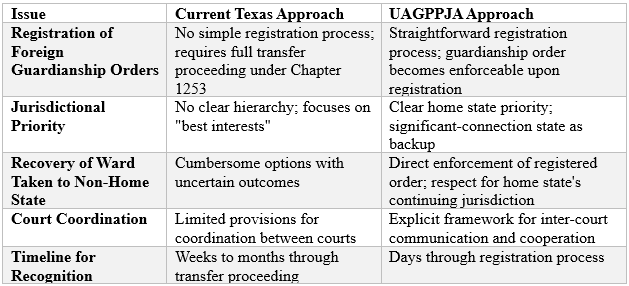
C. Texas's Failed Attempt: HB 2998 (2015)
In 2015, the Texas Legislature considered House Bill 2998, which would have added Chapter 1254 to the Texas Estates Code, implementing UAGPPJA in Texas.12 The bill made it to the General State Calendar but ultimately died without further action.
The bill's failure appears to have stemmed, at least in part, from the perception that existing provisions in Chapter 1253 (transfer and acceptance of foreign guardianships) adequately addressed interstate guardianship issues. Some stakeholders expressed the view that Texas's existing framework was "good enough."13
This assessment, however, fails to recognize the significant procedural advantages UAGPPJA offers—particularly in situations involving the recovery of wards improperly removed from their home states. The current Texas approach simply doesn't provide the efficient, predictable mechanisms that UAGPPJA would establish.
As of 2025, 46 states, the District of Columbia, and Puerto Rico have adopted UAGPPJA. Texas remains an outlier, creating unnecessary complications for guardians, wards, and courts dealing with interstate guardianship matters.
V. Conclusion: Navigating the Present, Advocating for the Future
The current landscape for recovering wards in Texas guardianship proceedings presents significant challenges. For in-state matters, guardians have several options, including direct enforcement through peace officers, motions in the guardianship court, contempt proceedings, and criminal complaints. Each approach has its limitations, and habeas corpus remains a potential last resort in particularly difficult cases.
For interstate matters, the obstacles are even greater, with no straightforward mechanism for an out-of-state guardian to secure a ward's return from Texas. The current options—formal transfer proceedings, new guardianship applications, or creative approaches with uncertain outcomes—fail to provide the efficient, reliable recovery mechanisms that vulnerable wards deserve.
Until Texas adopts UAGPPJA, practitioners should consider the following practical approaches:
For in-state matters:
Begin with the "Notice to Peace Officer" if appropriate
Pursue direct enforcement through the existing guardianship court
Consider contempt proceedings if specific court orders are violated
Reserve habeas corpus for situations where other remedies prove inadequate
For interstate matters:
Consider simultaneous pursuit of multiple remedies
Initiate the formal transfer process under Chapter 1253 while seeking temporary emergency relief
Document all attempts to recover the ward
Coordinate with the court in the originating state to maintain consistent approaches
The adoption of UAGPPJA would significantly improve this situation, providing clear, efficient mechanisms for both in-state and interstate recovery of wards. The registration provisions would be particularly valuable for out-of-state guardians seeking to recover wards improperly brought to Texas.
The legal system's fundamental purpose in guardianship matters is to protect vulnerable individuals who cannot protect themselves. When wards are taken from their lawful guardians, this protection breaks down. The current patchwork of uncertain remedies in Texas fails to provide the robust, efficient protection that wards deserve. UAGPPJA offers a proven solution that aligns with the practices of nearly every other state.
As members of the legal profession, we have a responsibility to advocate for laws that better serve vulnerable populations. UAGPPJA represents just such an improvement—a tested framework that would enhance protection for wards, reduce unnecessary litigation, and align Texas with national standards. The time has come for Texas to join the overwhelming consensus and adopt this important uniform law.
This article was prepared with generative AI assistance in research and initial drafting. The draft was subsequently edited and refined, and sources were verified by the author.
Footnotes
Tex. Est. Code §§ 1101.151(c), 1101.152(c). ↩
Tex. Gov't Code § 21.001(a). ↩
Tex. Penal Code § 25.10. ↩
Tex. Const. art. I, § 12. ↩
Tex. Code Crim. Proc. art. 11.01. ↩
Tex. Code Crim. Proc. art. 11.04. ↩
Tex. Code Crim. Proc. art. 11.22. ↩
Tex. Gov't Code § 25.0026(a). ↩
Id. ↩
Tex. Est. Code § 1253.053(d). ↩
Tex. Est. Code §§ 1253.051-1253.056. ↩
H.B. 2998, 84th Leg., Reg. Sess. (Tex. 2015). ↩
Judge Steve M. King, "Supports and Services and Selected Complex Issues in Guardianships," State Bar of Texas Advanced Guardianship Law Course (September 2, 2020). ↩
This is such meaningful information! Thank you!💯
Very informative